

For years, public institutions have been told that purchasing through one massive online marketplace saves time and money. A national investigation from the Institute for Local Self-Reliance (ILSR) suggests that the reality is far more complicated.
After reviewing purchasing records from 128 cities, counties, and school districts serving 51 million Americans along with data from 122 state agencies, contracts, and interviews with public officials, procurement experts, and vendors ILSR found that Amazon Business can expose public institutions to inconsistent pricing, limited accountability, and weakened local competition.
Innovative has spent decades building relationships with the schools, cities, and organizations we serve. We take the time to understand needs, provide tailored recommendations, and remain accountable long after an order is placed.
The report reinforces what we have always believed: relationships are not an outdated way of doing business. They are a smarter and more responsible way to manage public purchasing.
The Growing Scale of Amazon Purchasing
Cities, counties, and school districts spent an estimated $2.2 billion with Amazon in 2023 nearly four times what they spent in 2016. School districts accounted for approximately 70% of that spending, meaning many of the dollars at risk are intended to support classrooms and students.
Amazon is also expanding into state and federal procurement, making it increasingly important for public institutions to examine not only how easy a platform is to use, but whether it delivers consistent value, transparency, and accountability.

The Real Cost of Algorithm-Driven Pricing
Amazon Business does not always operate with fixed, negotiated prices. Its pricing can change throughout the day and vary between buyers, often without a clear explanation of why one organization paid more than another.
In one example cited by ILSR, a city paid $8.99 for a 12-pack of Sharpie markers while a nearby school district paid $28.63 for the same product on the same day.
Among the 100 most frequently ordered products reviewed, the highest price paid averaged 136% more than the lowest price paid for the identical item.
ILSR also found that a school district could have saved 17% across 2,500 commonly purchased products if it had consistently received Amazon's lowest available price.
Public institutions cannot confidently budget around prices that operate as a black box. Convenience means less when an organization cannot determine whether it received a competitive price.
A Better Purchasing Partner
ILSR compared Amazon with an independent office supply dealer across 628 frequently purchased school products.
The independent supplier offered a lower price on more than 68% of the items.
That finding challenges the assumption that Amazon is automatically the least expensive purchasing option. Public institutions should compare actual pricing rather than assuming an online marketplace provides the best deal.
The value of an independent supplier also extends beyond an individual product price.
Innovative's Brand Promise is built around Real People, Real Service and Real Solutions. That means customers work with dedicated teams who understand their needs, remain accessible, conduct research, provide tailored recommendations, and develop customized programs designed to improve efficiency.
The difference is not simply how quickly a product arrives. It is having a partner who understands the organization, helps identify the right solutions, and remains accountable for the overall result.
REAL PEOPLE
REAL SERVICE
REAL SOLUTIONS
Group Contracts Do Not Always Guarantee Better Pricing
Many public institutions purchase from Amazon through cooperative agreements, including contracts offered through OMNIA Partners. These agreements may be presented as competitively sourced purchasing solutions.
However, ILSR found that they often provide no fixed pricing, guaranteed discounts or meaningful protection against price fluctuations. Purchasing through one of these contracts can function much like shopping directly through the open Amazon Business marketplace.
According to the report, school districts purchasing through OMNIA contracts spent twice as much per student with Amazon as districts that did not.
A contract should provide more than access to a marketplace. Public institutions should expect transparent terms, competitive pricing and measurable value.
What Communities Lose
Public purchasing decisions affect more than an organization's supply budget.
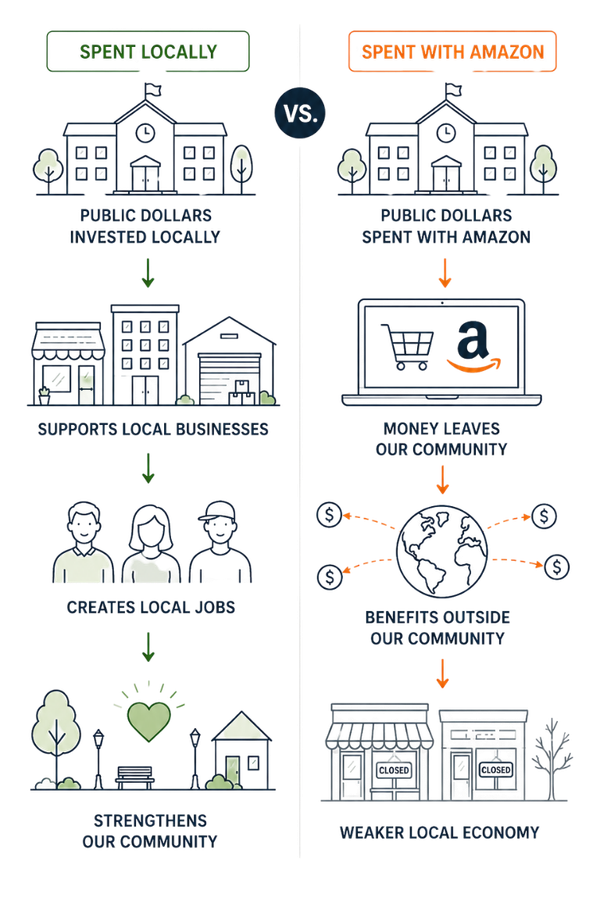
When public dollars are spent with independent and local suppliers, more of that money supports local jobs, tax revenue and community investment. When those dollars flow through a national marketplace, much of the economic benefit leaves the community.
In Berkeley County, West Virginia, a school district spent $1.3 million through Amazon Business. Only $142 went to sellers located within the state.
ILSR found similar patterns across the communities it studied: public dollars spent through Amazon overwhelmingly flowed to Amazon itself or to sellers located outside the purchasing community.
At the same time, the number of independent office products, furniture and janitorial suppliers nationwide has declined from approximately 1,300 to 900 over the past decade.
Public purchasing decisions help determine whether independent businesses, local expertise, and local jobs remain available to serve the community.
Accountability and Product Confidence Matter
Amazon's marketplace includes millions of third-party sellers and a constantly changing product catalog. This can make it more difficult to verify who supplied a product, whether it meets an organization's standards and who is accountable when an issue occurs.
In 2024, the U.S. Consumer Product Safety Commission determined that Amazon was legally responsible as a distributor for certain hazardous products sold by third-party sellers through its Fulfilled by Amazon program. The Commission later ordered Amazon to notify purchasers and provide remedies for affected products.
ILSR's investigation also identified questionable government purchasing-card transactions made through Amazon, including purchases with no apparent connection to public business.
Independent suppliers work with established manufacturers, distributors and vendor partners. Customers know who provided the product, who recommended it and who will help resolve the issue if something goes wrong.
Amazon Is Moving Further into Public Procurement
Local government purchasing is only one part of Amazon's growing public-sector presence.
States collectively spent at least $250 million with Amazon Business in 2023, although weak tracking systems may mean the actual amount was higher.
At the federal level, Amazon captured 96% of sales during the first two years of the General Services Administration's Commercial Platforms Program, which allows agencies to make certain purchases without following traditional competitive bidding processes.
As purchasing becomes increasingly centralized through online platforms, public institutions risk replacing competition and transparency with convenience.
INCREASED RISK CENTRALIZING PURCHASES THROUGH ONLINE PLATFORMS
Communities Are Choosing Another Path
Some governments have reduced their reliance on Amazon and redirected spending toward competitive and local suppliers.
Tempe, Arizona, rejected an Amazon cooperative purchasing contract and reduced its Amazon spending by 84% between 2017 and 2023.
Phoenix has spent very little with Amazon over the past decade by requiring competitive local bids for many purchases.
These are not symbolic decisions. They are practical purchasing strategies designed to strengthen competition, improve accountability and keep more public money within the communities that generated it.
Why Innovative Is Different
Innovative is not an anonymous marketplace governed by constantly changing algorithms.
We are a workplace partner focused on understanding each organization and helping it operate with confidence. Our independent structure allows us to remain responsive while offering the reach, expertise and complete portfolio organizations expect from a national provider.
Innovative provides:
This is our Brand Promise: Real People. Real Service. Real Solutions.
It is why schools, municipalities and organizations across the region have trusted Innovative for decades. Because when public dollars are involved, organizations deserve more than an algorithm. You deserve a partner.